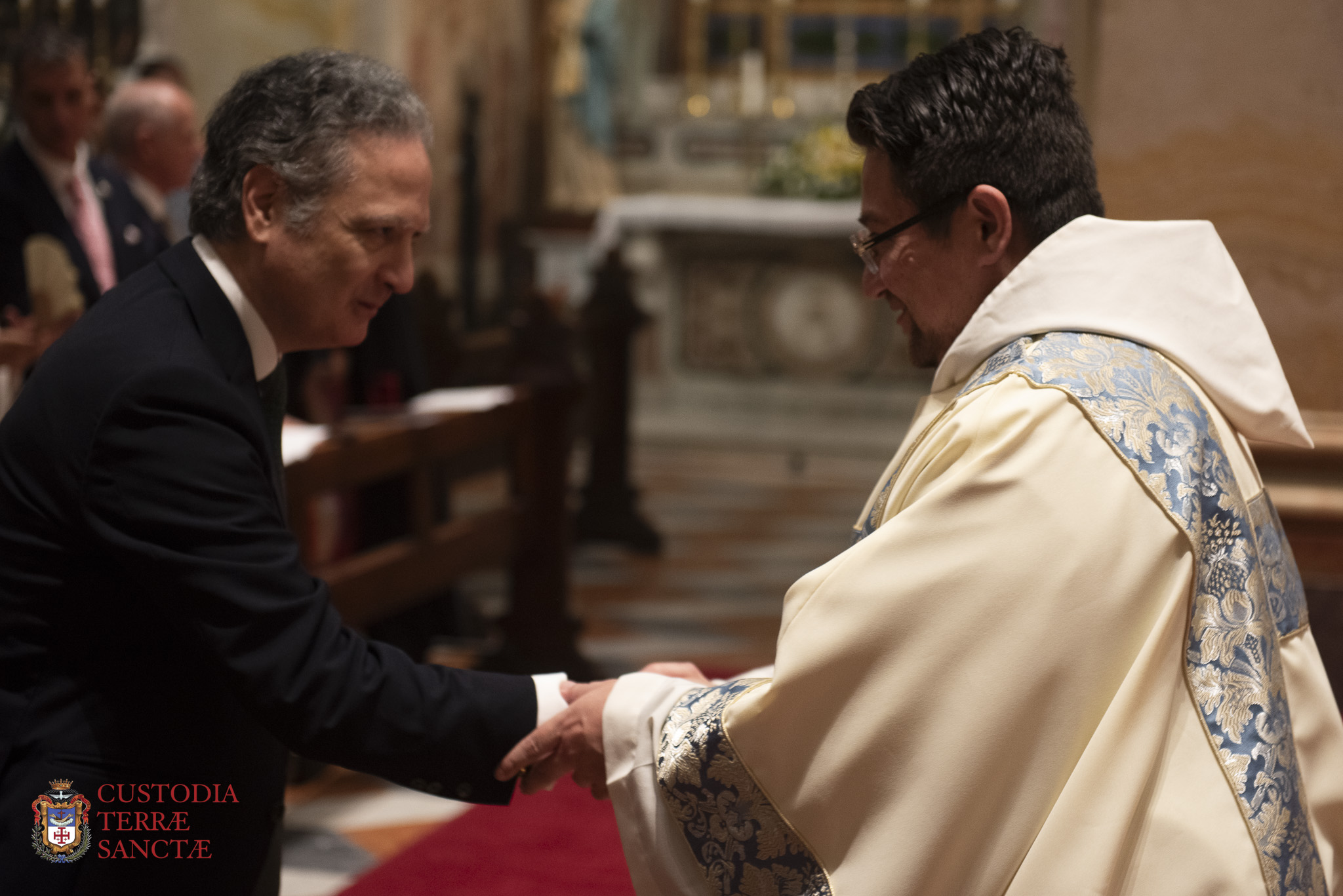
A land wounded by war, divisions, violence and poverty. A land where the Christian community lives with a deep sense of belonging but also great anxiety. And yet, precisely in a Syria full of pain but also an ancient cradle of Christianity, the seeds of hope continue to sprout. And Saturday, September 19, for the Christian community of the country and for the entire Custody of the Holy Land, was one of those days that reminded us that even in suffering and difficulties, the Church continues to have moments of joy, belonging to the faith, emotion and great spirituality. In the Church of the Conversion of Saint Paul the Apostle in Bab Touma in Damascus, in fact, the Catholic community gathered to celebrate the solemn profession of Fr. Fares Mardini. Into the hands of the Custos of the Holy Land, Fr. Francesco Ielpo, the young friar pronounced his definitive “yes” to consecrated life in the Order of Friars Minor, making the vows of obedience, poverty and chastity. And in this fundamental passage of his life, Fr. Fares was accompanied by the entire local community and the Franciscan fraternity.
At the heart of the liturgy was the awareness that God’s call opens a path that often goes beyond the criteria by which the world measures happiness. And precisely for this reason, the homily of the Custos began with the words of the prophet Isaiah: “My thoughts are not your thoughts, nor are your ways my ways”. Addressing Fr. Fares, Ielpo recalled how the life chosen in the footsteps of Saint Francis of Assisi may appear to the world as a renunciation of happiness. However, the Custos recalled that obedience, poverty and chastity are instead three paths to live one’s life “in fullness, according to the Gospel”. Freedom, Ielpo stated, consists in entrusting one’s will to the Lord with confidence. True wealth, instead, is having God as one’s only treasure. While the fullness of love is expressed not in keeping someone for oneself, but “in giving one’s entire life to God and to one’s brothers and sisters”.
The Custos then recalled the parable of the workers in the vineyard. A story in which Jesus explains that “the greatest grace is not the reward we will receive at the end, but having been called to work in the Lord’s vineyard”. A new awareness, different from what may be considered normal in the eyes of the world, which also builds a sense of fraternity. Not a place in which to compare merits, services or talents, but “where we learn to rejoice because the Lord has called each one of us and continues to be good to everyone”. From here came the invitation also addressed to Fr. Fares. “Never lose the wonder of having been called”, the Custos concluded, “do not live your consecration as a burden to be endured, but as a gift to be welcomed every day”. A joy and a grace in which Fr. Fares will not be accompanied only by his family and friends, but by the entire Franciscan family.
Lorenzo Vita