There is an image that I cannot forget. I was on retreat at the hermitage of Gethsemane - right there at the foot of the Mount of Olives, where Jesus sweated blood on the night of his betrayal - when I saw a Franciscan friar doing a very simple thing: during Mass he recorded his homily. Not for himself, but to send it via message to his contacts, so that that Word would not remain closed within the stone walls of the sanctuary, but would reach those who needed it.
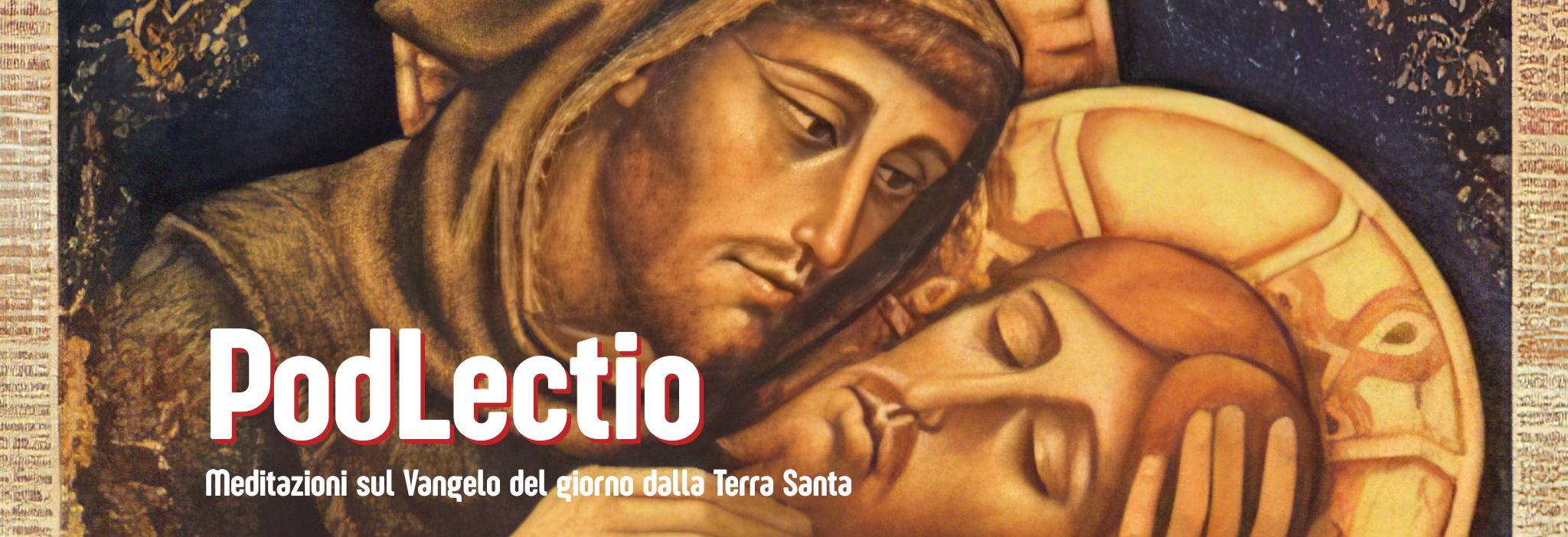
It was a spark. I said to myself, why not do it in a systematic way? Why not systematize that spontaneous act of sharing, giving it a form, a distribution, a home? Thus was born PodLectio, a daily podcast of meditation on the Gospel of the day, produced in collaboration with the Press Office of the Custody of the Holy Land, which immediately welcomed the idea and made it its own, and now in its seventh consecutive edition this year.
The basic idea is one of evangelical simplicity: every day, during the strong times of Advent and Lent, a friar from the Custody of the Holy Land sits-or walks, or gathers in a corner of the sanctuary-records by himself his meditation on the Gospel of the day and sends it to me. Then it's my turn to do the editing. No direction, no professional studio, no budget. Just the voice of a friar, the Word of God, and technology doing its humble service.
St. Francis of Assisi, who liked to call himself a "herald of the great King," never tired of bringing the Gospel to everyone he met, in streets and squares. Today those streets are called Spotify, YouTube, Amazon Music, Apple Podcasts. And the steps - digital - can be counted in the thousands.
PodLectio is distributed on all major audio and video streaming platforms. But the most eloquent confirmation of its value came from an authoritative and unexpected source: Vatican News, the official media of the Holy See, asked to include the podcast in its daily programming. The first time it was us who proposed it; from the second time on, it was they who sought us out. A signal that speaks for itself.
The seventh edition ran from Feb. 18 - with a bonus episode of presentation - to April 3, Good Friday, for a total of forty-four episodes. One for each day of the Lenten journey to the Cross.
The friars recorded from the most evocative and significant places imaginable: Jerusalem and its shrines, Syria, Cyprus, Greece, Lebanon, Jordan, Palestine, Israel. And then Italy, with a special presence of five friars from Assisi, including the Minister Provincial, to mark the eighth centenary of the Seraphic Father's transit. In all, forty-two friars, practically one for each day of Lent, as if it were a spiritual relay through the geography of apostolic custody. Among the most authoritative voices is that of the Custos of the Holy Land, the protagonist of no less than three episodes: the opening one, the final one and the special Good Friday episode, entirely dedicated to the appeal for the Collect pro Terra Sancta.
Cyprus also brought the voice of Bishop Bruno, a sign that the project was able to involve not only the friars engaged in the various tasks (guardian, professor, bursar, parish priest, etc.), but also the episcopal leadership of the community. And from all the countries of the Custody - from Damascus to Nicosia, from Beirut to Amman, from Nazareth to Bethlehem - the Word left in audio format to reach faithful in every time zone. Just to try to be as international as possible, for two editions we also had a Spanish-language season added to the one in Italian. And even there we had a lot of feedback.
As St. John Paul II wrote in his encyclical Redemptoris Missio, "The first areopaguses of the modern world are the mass media." PodLectio seems to have taken that indication seriously.
Those in communications know that numbers alone do not tell the whole story. But sometimes they tell a story worth reading.
In the seventh edition, Spotify recorded 15,908 plays, totaling more than a thousand hours of listening. A figure, the latter, that reveals something interesting: more than one believer returned to listen to the same episode several times. The meditation, evidently, deserves to be ruminated upon-as is the tradition of lectio divina from which the podcast takes its name.
Total individual plays exceeded 45,000, with an average of 256 listens per episode. The most listened to episode was Ash Wednesday, with 384 plays; the least listened to stopped at 213 - a figure that, in each case, represents 213 people who stopped to listen to the Gospel meditated by a friar in the Holy Land on that day.
To understand the magnitude of this growth, a comparison is enough: in previous editions, the average per episode was between 50 and 80 listens. We have gone, within a few years, to more than triple that. To Spotify's data, one must add those of YouTube (both the Custody channel and the dedicated PodLectio channel), Amazon Music, Apple Podcasts and, of course, Vatican News, which reaches a worldwide audience.
Pope Francis, who has made authentic and forthcoming communication one of the hallmarks of his pontificate, wrote in his Message for the 57th Day of Social Communications that "to communicate is to build bridges, to foster encounters between people." PodLectio builds bridges every morning, one episode at a time.
There is one aspect of PodLectio that, in an age dominated by market logic and advertising investment, sounds almost revolutionary: it costs nothing. The brothers record themselves, with their own phones. There are no recording studios, no cachet, no distribution fees. Editing is artisanal, carefully done but without expensive tools. Distribution platforms are free or almost free. The only currency spent is time - that of the friars who stop daily to pray and share - and the passion of those who coordinate the project and those who collaborate on it, such as the volunteer who reads the Word of God. Although sometimes, we also used artificial intelligence.
Yet the return is incalculable. Not in economic terms, of course, but in terms of souls reached, of faithful accompanied on the Lenten journey, of people who might never have been able to go on pilgrimage to Jerusalem and who every morning, in the subway or in the kitchen while making coffee, can hear the voice of a friar praying on the same stones on which Jesus walked.
St. Maximilian Kolbe, a pioneer of Catholic communication in the twentieth century, was convinced that the media were a "modern cathedral" through which to bring the Gospel to those far away. PodLectio does not have the grandeur of a cathedral, but it has the simplicity of a small chapel that is always open.
The numbers are important, but there is one indicator of success that no analytics platform can measure: the enthusiasm of the friars. We receive requests to participate all the time. During Advent, when there are fewer bets and fewer places available, many friars complain about being left out. Some wait their turn from one edition to the next.
This is perhaps the most authentic sign of the goodness of the project: not a figure on a screen, but the concrete voice of consecrated men who want to share their prayer with the world. Friars who, from the heart of lands often marked by war and suffering - Syria, Lebanon, Palestine among others - choose to raise their voices not to protest, but to pray. Not to complain, but to meditate on the Gospel.
After all, that is exactly what that friar did at Gethsemane that morning that changed everything: he recorded his homily not for himself, but so that someone else could hear it. PodLectio has only expanded that gesture. From the courtyard of a hermitage to forty-five thousand listens, from a friar's phone to the ears of the world.
The Word, like bread, must never be lacking.
PodLectio is available on Spotify, YouTube (Custody of the Holy Land and PodLectio channels), Amazon Music, Apple Podcasts and Vatican News.
Nello Del Gatto