March 20, 2026
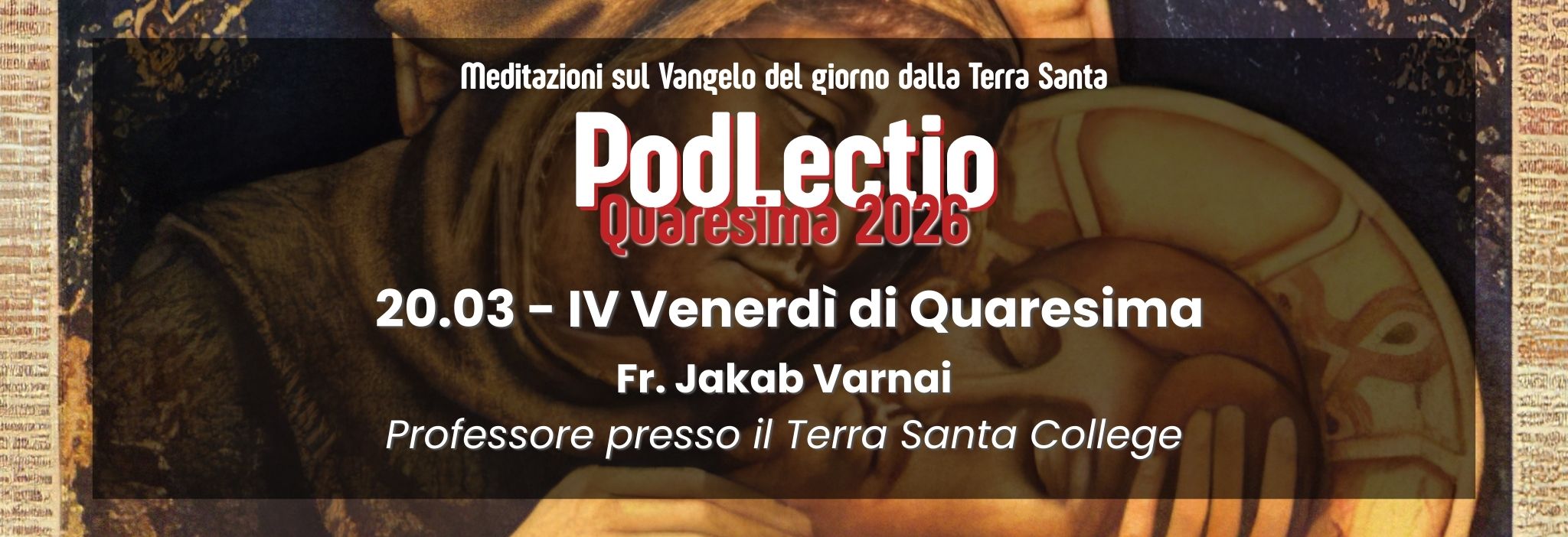
IV Friday of Lent
Fr. Jakab Varnai
Peace and good.
I am Jakab Varnai, a Hungarian Franciscan friar in service of the Custos of the Holy Land. I speak from the convent Terra Santa College in Jerusalem. We have heard a typical motif of the Gospel of John.
Jesus speaks at his own level, divine, not human, and those who do not know him speak. Once again there is a contrast between the human view of "We know where this man is from" and the divine view of "He who sent me is true". Let us enter into the ultimate mortal conflict.
As in the whole Gospel of Saint John, Jesus has a wonderful clarity about his destiny, he awaits his hour, he fulfills the will of the Father, he follows the divine mandate. Why did they condemn Jesus to death? In his divine vision it is clear, so that the glory of the Father may be manifested and the world may have life. At the human level, however, at our level, where we seek to understand causes and effects, motives and reasons, his condemnation takes place in a complicated situation.
Alongside the simplicity of Jesus' divine vision of his condemnation, we can and must admit the complexity at the human level. At this level, the condemnation of Jesus did not have only one single reason. Indeed, it would be a fundamental error to seek a single reason why Caiaphas arrested Jesus.
This is why it is important always to consider the entire context of the condemnation of Jesus as a whole composed of the following elements. We see that already his public mission involved four elements that put him in conflict with the religious mind of rabbinic Judaism. Jesus proclaimed that the kingdom of God was coming and would put an end to the current world order and the order of Israel and that the twelve tribes would be restored.
Jesus claimed to be able to teach the will of God to others with authority, even if this went against the Mosaic laws. Jesus was able to gather large crowds behind him and created a close circle of twelve people as a symbol of the twelve tribes. Jesus behaved with extraordinary freedom when he ate with tax collectors and sinners.
This is already inflammable material, but if we add to this that many of his followers considered him the Davidic Messiah and that Jesus made the claim to have a decisive role in the eschatological drama, then this is already dangerous in the eyes of the religious institution. This situation, dangerous for them, intensifies with the events before Passover. Jesus enters Jerusalem triumphantly and purifies the Temple.
Then this is already a barrel of gasoline for the chief priests. This would be accompanied by the claim to perform miracles as tangible signs of his coming kingdom and of the justification of his claims over Israel. Elements of conflict, all of these, that create an increasingly complicated situation.
This is our historical world. And in this world resounds the answer of Jesus with divine simplicity. "I have not come of myself, but he who sent me is true".
Jesus, Mary and Saint Francis accompany you on this day.
Peace and good from the Holy Land.