
Eight hundred years after his Transitus, Saint Francis still speaks to millions of people throughout the world. His radical choice, his being poor among the poor, his texts and his charism still kindle the hearts of many faithful of every age and from every part of the world.
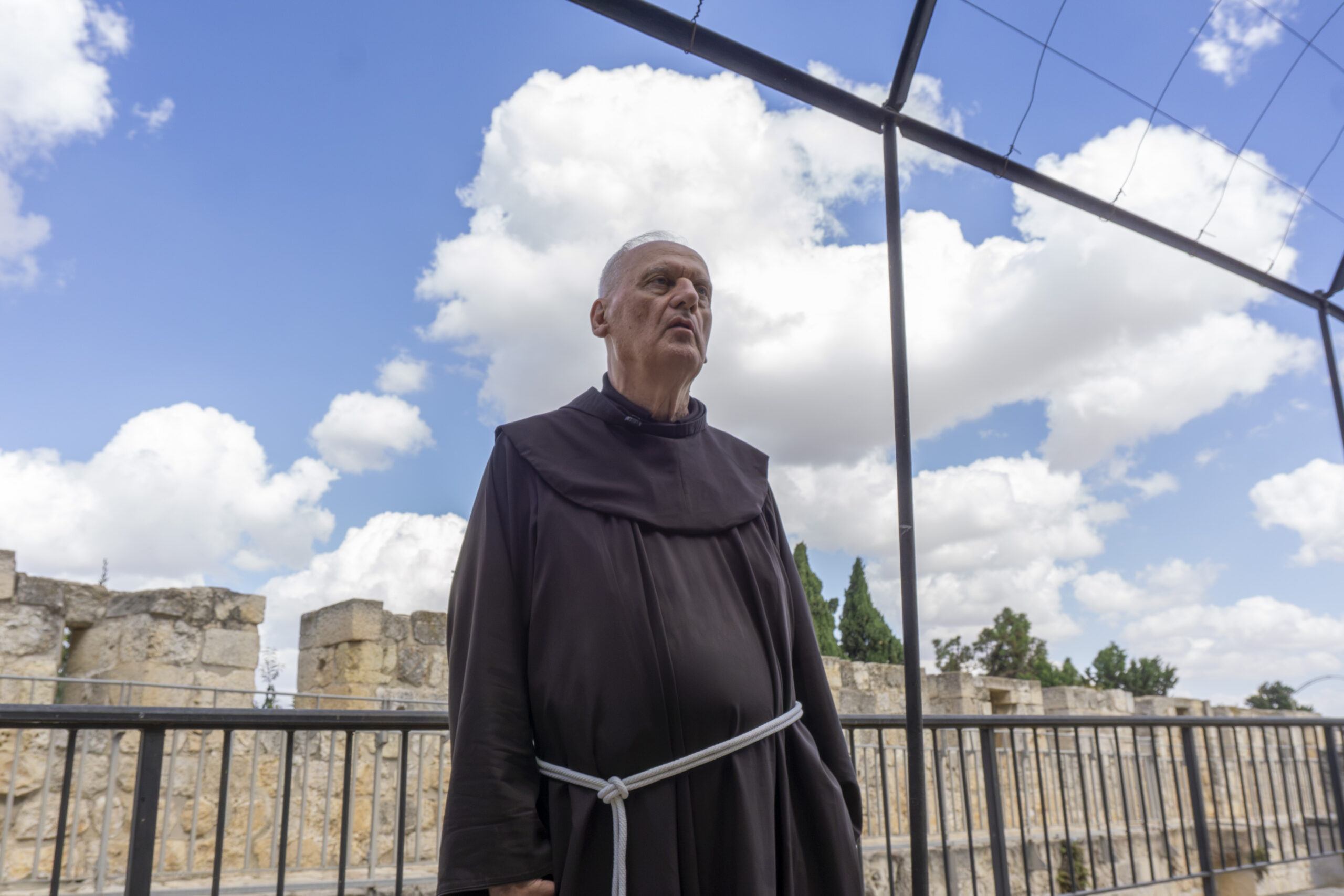
To understand this moment, which is so important for the entire Franciscan family, we spoke with Fr. Cesare Vaiani, who is in Jerusalem for the Triduum in preparation for the Feast of Saint Francis. Fr. Cesare Vaiani has been studying and teaching spiritual theology, the history of spirituality and the experience of Francis of Assisi for more than thirty years. He has devoted numerous publications to these subjects, also exploring the relationship between Francis and Clare, the Rule, the Writings of the Poor Man of Assisi and some fundamental aspects of the Franciscan tradition. And for this reason, his commentary is even more important in helping us understand why Francis still speaks to us today, in the Holy Land and throughout the world.
What does it mean to celebrate the 800th anniversary of St. Francis’s passing?
I believe that centennial anniversaries are always an opportunity to return to the sources, to the origins. And so, these 800 years mark an important moment to reconnect with that source and translate it into the present day. This occasion is not celebrated only by us friars, who are obviously a bit more interested and involved, but on many levels, in somewhat unexpected spheres. And this is proof of Francis’s relevance today, he draws people in not only through his mystical and religious dimensions but also through his fraternal concern for Creation. This social friendship, which extends to every person, is what Pope Francis evoked in his encyclical Fratelli tutti. These are different aspects of Francis’s person, and it’s easy for someone to often absolutize just one of them or see only that one. But perhaps that’s all right too: each person grasps the elements that resonate most deeply with their own sensibility. I believe Francis has something to say to the men and women of our time, offering a solution that captivates through its simplicity, its poverty, and the possibility of being put into practice without the use of great human resources, but with that intensity of heart and mind that each of us can bring to what we do.
What aspects of the Franciscan way of life might appeal to a young person today?
I believe there are very different types of young people today. As is always the case, of course, but the younger generations in particular have different sensibilities and expectations that I’m not sure an older person like me can fully understand. I believe that one element that can still fascinate a young person today is that of freedom and poverty. And I link freedom and poverty because I am speaking of that freedom which arises from poverty, from a conscious focus on what is essential. This is what poverty is: it is not merely the renunciation of possessions, but a way of using things and possessions without that attachment that makes managing them burdensome. An inner detachment that allows one to enjoy and take pleasure in good and beautiful things, but without claiming them as one’s own. I believe this dimension is an essential aspect of Franciscan spirituality and is also something that can appeal to young people—as I believe it does to everyone.
So is this, then, what freedom is?
In this detachment from things lies great freedom, because the bond, which is the opposite of freedom, is precisely this spirit of possession and appropriation, which makes us slaves to what we believe we possess and which, in the end, possesses our hearts.
Let’s imagine Fr. Francis entering a Franciscan community today, what would he ask us to examine in our lives? What would he look for, and what would he find?
At the end of his life, there is a very beautiful saying by Fr. Francis, who, as he lay dying, addressed his brothers: "I have done my part; may Christ teach you yours." What Fr. Francis is telling us is, on the one hand, his own testimony—though it is rooted 800 years ago in his life’s journey—and on the other hand, he invites us to turn to Christ, that is, to find for ourselves the solutions or, at any rate, the proposals that can be useful for today’s world. I don’t believe it’s possible to find them directly by applying Fr. Francis’s experience to our own time, which is so different, but I do believe his invitation is for us to become the protagonists of our own choices today. And the choices that are perhaps most in tune with him are those embodied in the name he chose for himself and his brothers: brothers and minors, that is, fraternity and minority. A fraternity that is a bond of closeness, equality, and proximity to every person, indeed, to all creatures, but as “minors,” that is, as the “lesser ones,” with attention therefore to those who are smaller, yet also with the resolve not to be greater than those beside whom we stand. This is what ultimately puts everyone at ease when approaching Saint Francis; they do not see him as someone standing on a pedestal, but as someone who comes and goes alongside them as a brother and a “minor.”
What binds Fr. Francis so deeply to the Holy Land? And what does it mean today to preserve the Franciscan insight of coming here, to this place?
Fr. Francis’s bond with the Holy Land is linked above all to his journey to the East, when he also met the Sultan. And he proposed to the brothers two ways of being in these places. These two ways remain entirely relevant even today. The first is that they should not engage in quarrels or disputes, but should be submissive to every human creature and profess that they are Christians. The first way, therefore, is that of a humble, submissive presence - as brothers and, indeed, as “minors”- confessing that they are Christians. The second way states: when it pleases the Lord - that is, not in every situation or at all times, but when you realize that the time is right - proclaim the Word of the Lord. I believe this is, in practical terms, the way, even today, to be present in these countries: first and foremost with a silent and submissive presence, and with a word, when possible, that explicitly proclaims the Gospel. And this, it seems to me, is how the Custos have interpreted their presence in these Holy Places for 800 years. At the same time, however, there is also closeness to the people: activities to support and assist the people who live there and the care of these places. This stewardship is linked to the importance of the Incarnation in Franciscan spirituality. God who becomes flesh in concrete places, in specific situations. And here, for 800 years, the Custos have been caring for the places where the Lord lived, precisely in remembrance of his humanity and his Incarnation.
Lorenzo Vita and Riccardo Curti


