December 18, 2025
Third Thursday of Advent
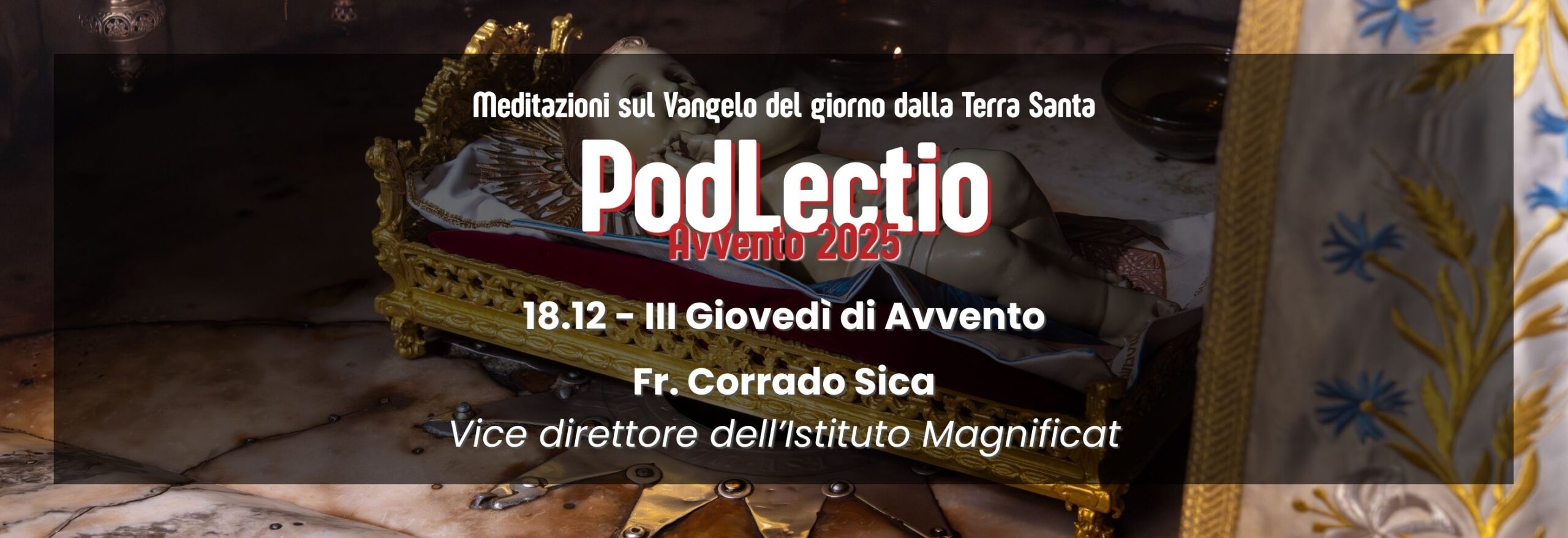
Fr. Corrado Sica
May the Lord give you peace.
I am fr. Corrado Sica, titular organist of the Holy Sepulchre, deputy director of the Magnificat Musical Institute. I live in Jerusalem in the Convent of St. Savior.
The Gospel passage from Matthew in Chapter I, verse 18-24 recounts the annunciation of Joseph and presents him as a model of faith, obedience and justice.
Already from the first verses, 18-19, we are confronted with the crisis of a righteous man. Mary is pregnant before married life. Being righteous is the main characteristic of Joseph. For the Jewish law of the time, being righteous meant observing the Torah scrupulously, so discovering Mary's pregnancy before marriage constituted a breach of the law.
But Joseph's justice is not cold or rigid, for if he had applied the law to the letter, Mary could have suffered a public trial with extreme consequences. Instead, his justice is tempered by mercy and discretion. He seeks a humane and private solution, secret repudiation. Joseph acts according to human logic and the law, trying to do the right thing in the least painful way possible for Mary.
In the next verses, 20-21, however, we catch a glimpse of God's intervention and revelation. As Joseph ponders his plan of action, God intervenes, twisting his human logic through a dream.
Dreams are the privileged place of divine revelation and guidance, and an angel introduces God's perspective, which is different from the human one. He tells Joseph not to be afraid, but to trust in God. His message reveals the mystery of the incarnation, a fatherhood that is not human but divine. Joseph's fatherhood will be to name, acknowledge legal paternity and authority over the child. In essence, Joseph is called to assume a paternal role, although not a biological one.
In the last verses, 22-23, there is a prophetic confirmation. The prophet Isaiah is quoted to show that Jesus is the expected Messiah, foretold in scripture, in which the incarnation is God becoming close to humanity. And finally an obedience-reception in verse 24, given by Joseph's immediate and unconditional response.
There is no questioning, hesitation or procrastination. Joseph trusts God blindly. His righteousness is now manifested as obedience to the revealed divine will, overcoming his initial interpretation of the law. In conclusion, the passage proposed in this third week of Advent sheds light on the contrast between the human plan and the divine plan. Joseph, though a righteous man, does not understand the mystery until God himself intervenes.
His greatness lies not in his ability to understand everything, but in his readiness to obey with faith and silence. Joseph becomes the guardian of God's mystery, protecting Mary and the child, ensuring Jesus' legal inclusion in David's genealogy, thus fulfilling the messianic prophecies.
He is a model of faith who trusts God's word even when that word appears incomprehensible or scandalous to human logic. His silent and obedient faith does not need direct visions, but reception of God's will through the dream and the word that is proclaimed to him, manifesting his righteousness not as a rigid application of the law, but as a readiness to welcome the mystery that disrupts his plans.
This confirms the God with us, the Emmanuel, often manifests himself in unexpected ways and requires an act of trust and acceptance, even when human logic would suggest otherwise. And Joseph becomes a model of this response to God's call.
Through listening to God's word, we act with love and protection toward God's plan.
Peace and good from the holy land.