December 17, 2025
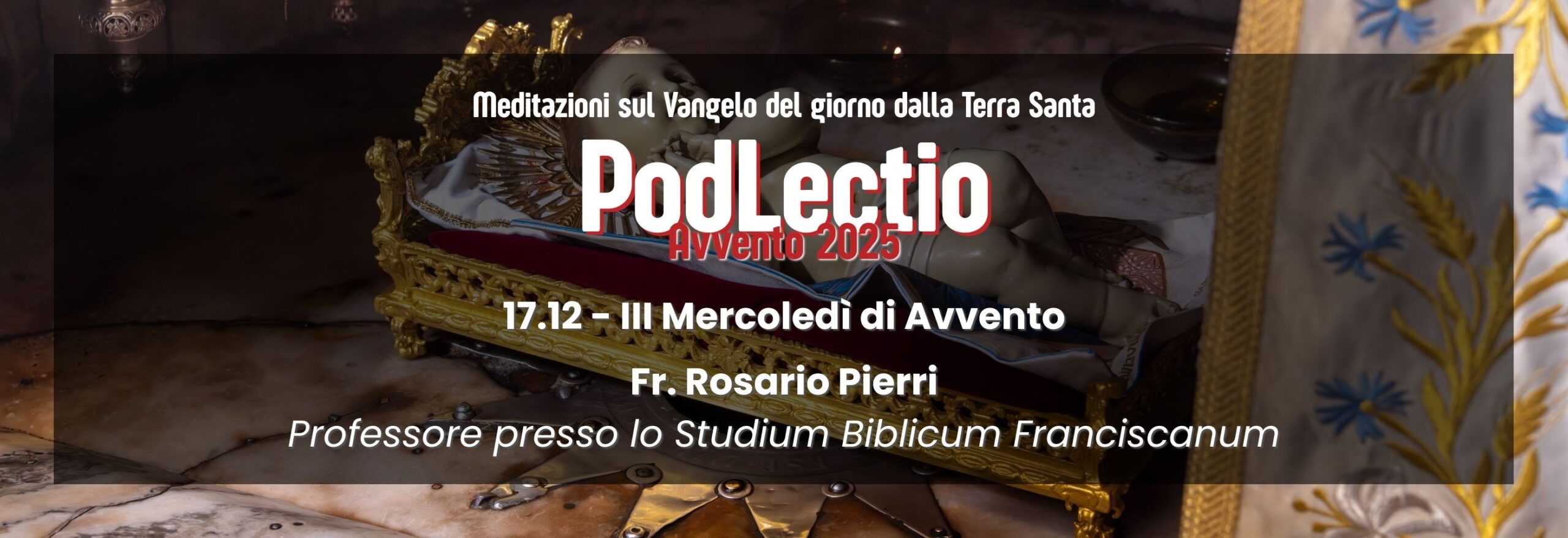
Third Wednesday of Advent
Fr. Rosario Pierri
Dearest brothers and sisters, may the Lord grant you his peace. I am fr. Rosario Pierri, speaking to you from the Studium Biblicum Franciscanum of Jerusalem.
Why a genealogy as the opening of the Gospel of Matthew? It was necessary to go back to the Patriarchs, because Jesus had said that he was the Messiah. The genealogy, therefore, is the demonstration, or if one prefers the proof, that Christ, the Anointed One, the Messiah, according to the flesh, descends from Abraham and David. If we are not accustomed to such long sequences of names, the Jews were instead, since they used genealogical tables to distinguish the members of the various tribes to which specific regions of the promised land had been assigned.
It is not possible to review all the figures mentioned. We would venture onto rather tortuous paths. Certainly the Evangelist proceeds while respecting a rigorous logic. Thus he mentions Isaac, but not the other sons of Abraham. Jacob, but not Esau. The reason for this omission is simple.
The Messiah would be born in the line of Isaac and Jacob, and not that of the brothers, and it is this criterion that is applied in the choice of names. Breaking the custom of avoiding female names in genealogies, the Evangelist mentions, in addition to Mary named at the end, four women, whose personal stories were not particularly brilliant, at least for three of them, Tamar, Raga and Bersabea, who is not recalled by name, but as the one who had been the wife of Uriah. Standing out among the four women, to the point of having deserved a short book to recount in broad lines her life, is Ruth, the Moabite, a non-Jew, grandmother of esse, father of David.
In our eyes the genealogy goes well beyond its immediate purpose of certification and descent. Through that sequence of names, in reality, a history is condensed for us which, behind the scenes of many lives, leads to the birth of the Messiah. Of all these figures, men and women, we know their lives, at least for the little that Scripture has handed down to us. Each of them, to different degrees, moves consciously within a flow of events behind which a divine plan is being realized. They are not, however, extras or manipulated characters, but men and women in the full sense, with the virtues and limits of their peers of every age.
A key to reading this interweaving is offered to us by the prophet Isaiah. God’s designs are hidden from us. Nevertheless, the word of God, even amid the contradictions and imperfections that mark human life, accomplishes His purposes. So shall my word be that goes forth from my mouth; it shall not return to me empty, without having accomplished what I desire and without having fulfilled that for which I sent it.
The work of God will never cease to astonish us. Behold, the Virgin shall conceive and bear a son who shall be called Emmanuel. Of the children of Tamar, Racab and Persevea, Ruth, in fact, it is said that the fathers begot them from their respective wives.
Taking Boaz as an example, we are told: Boaz begot Obed from Ruth, not so in the case of Mary. Jacob begot Joseph, the husband of Mary, from whom Jesus was born, who is called Christ. The Virgin will give birth to Jesus by the work of the Holy Spirit, and not by Joseph; indeed, without him knowing her, she bore a son whom he called Jesus.
Behold the marvelous work accomplished by God. The birth of the Savior is the true reason for the history recounted to us by the genealogy we have read. What precedes the event of Bethlehem has meaning only in its light.
Abraham and David, therefore, are certainly two eminent representatives among the ancestors of Jesus, but they remain always two links in the call to prepare the coming of the Messiah. God chose them to accomplish the work that will be fulfilled in Bethlehem, the birth of the Word of God made man. That child will grow in wisdom, age and grace before God and men, and will accomplish the will of the Father.
Jesus will say of himself, in a context of controversy, Abraham, your father, rejoiced in the hope of seeing my day; he saw it and was glad. Making these last words our own, let us rejoice with joy in the expectation of the birth of our Lord Jesus. Even if the memory of so much suffering, near and far, casts a veil over our happiness, sadness and pessimism will not be able to obscure it, certain that the Lord, Emmanuel, is with us.
Peace and good from the Holy Land.