“You are completely beautiful, Mary, and the original stain of sin is not in you”: these are the words that open the hymn “Tota Pulchra”, which from the 4th century have supported and borne witness to the faith of Christians in the immaculate conception of Our Lady. This hymn has always echoed between the walls of Franciscan convents and has formed the hearts of the friars, well before the proclamation of the dogma (1854) to venerate the Immaculate Virgin Mary.
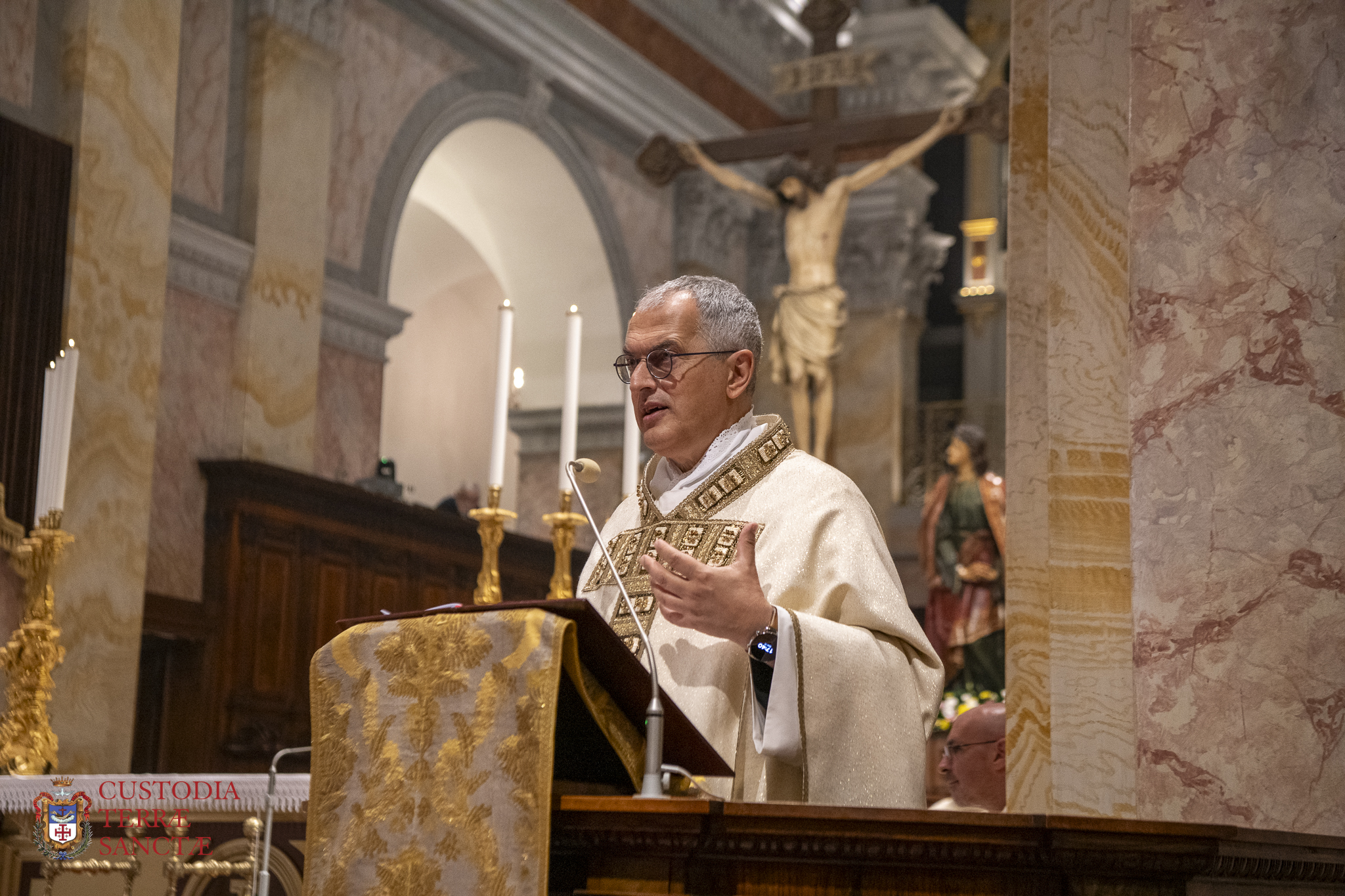
“In a time of theological disputes, the friars did not sing this hymn in Church, to avoid scandals and controversies, they decided to sing it in the refectories, after the Saturday dinner, to show their devotion to Immaculate Mary. “We still keep this tradition today,” says Fra Davide Pintabona, who this year is guiding the Meditations of the Triduum in preparation for the solemnity of the Immaculate Conception, organized by the Custody of the Holy Land in St Saviour’s church in Jerusalem.

“It was Francis himself who chose the Immaculate Virgin Mary as the patron saint and queen of the Seraphic Order,” said Fra Davide. St Francis of Assisi (13th century), “loved with an unspeakable affection the Mother of the Lord Jesus Christ, forasmuch as that she had made the Lord of glory our Brother, and that through her we have obtained mercy. In Her, after Christ, he put his chief trust, making her his own patron and advocate and those of his.” (Legenda Majore, IX). Those who were greatly devoted to and supporters of the Immaculate Conception include the Franciscan saints Anthony of Padua, Bonaventure of Bagnoregio, John Duns Scotus, Bernardino of Siena and Leonard of Port Maurice. It is also thanks to their works that the dogma of the Immaculate Conception for the whole of the Church was proclaimed in 1854.
He was nicknamed “Doctor Subtilis” (Dr Subtle) for his penetrating theological thought. Pope John Paul II, on the day of his beatification, defined him the “cantor of the Verb Incarnate and defender of the Immaculate Conception of Mary.” John Duns Scotus, a Scottish Franciscan, lived in the second half of the 13th century, studied in Paris and taught theology in England, France and Germany. He was a passionate defender of the privilege of the Immaculate Conception of Mary and it is to him that we owe what is known as the “preventive or preservative redemption theory,” according to which Our Lady had been redeemed by Jesus, but with prior redemption: before and outside time, in foresight of the merits of her Son. It is precisely this argument that allowed overcoming the obstacles laid down by other theological schools.
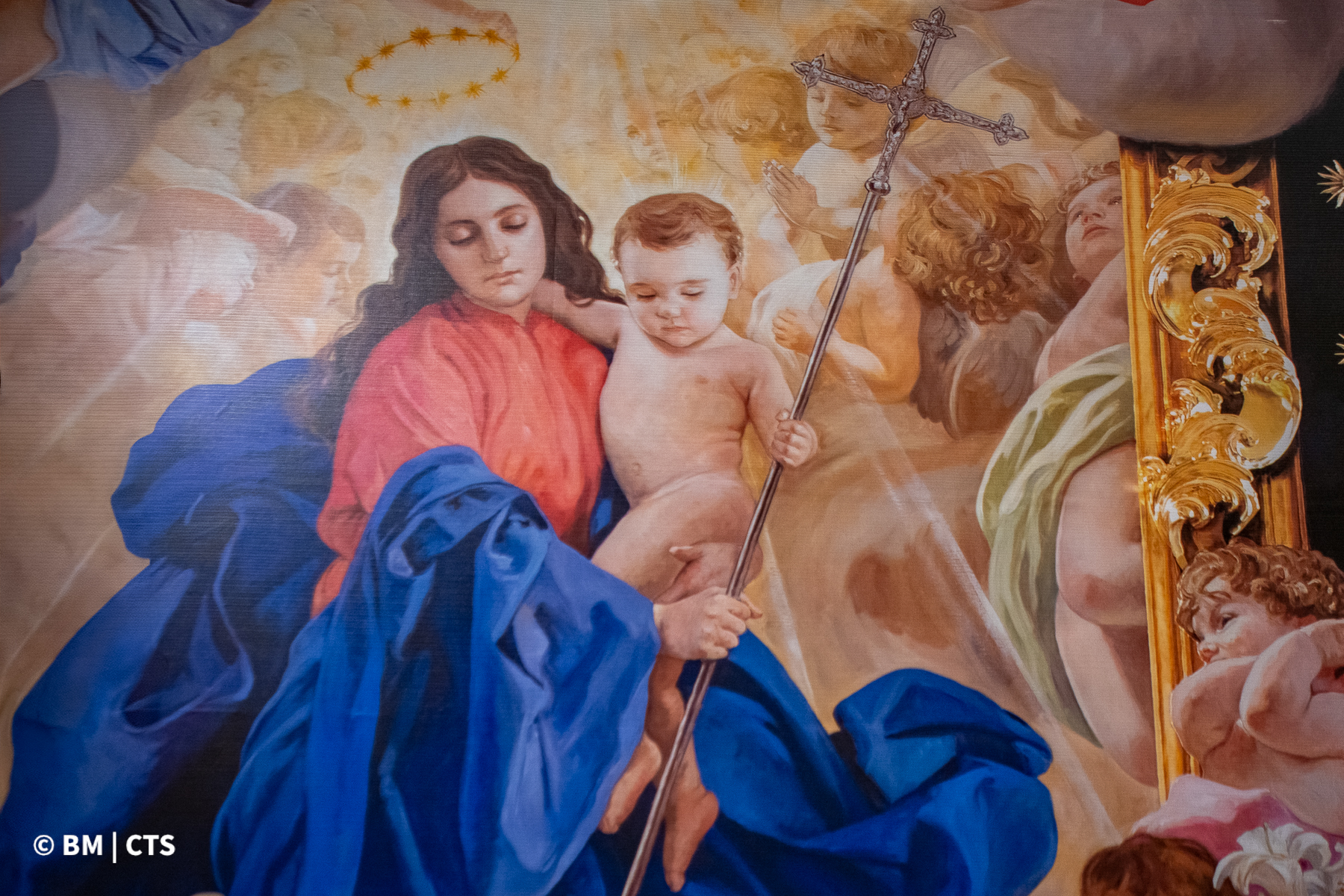
An altar dedicated to the Immaculate Virgin Mary, with a reproduction of the painting “Immaculada franciscana” by the Spanish artist Raúl Berzosa, has recently been installed in St Saviour’s church. The paining (oil on canvas, 196 x 324 cm) was created using different techniques (mixture of oil painting, sculpture, jewellery abd ornamental engraving with fine gold) for the canopy of the Virgen del Sol of Seville, which is taken in procession every Holy Saturday.

In the Franciscan tradition, the Immaculate Virgin Mary in portrayed holding the Child Jesus in her arms, indicating that it is due to the merits of her Son that Mary is pure: it is He who removes sin from world, with his incarnation, passion, death and resurrection. This is well represented in the scene in which Mary crushes the snake and holds a lance in her hand, but it is Jesus that pierces it.
Berzosa permitted the reproduction of the work for the altar of St Saviour, accompanying it with a description: “The composition focuses on the Franciscan Immaculate Virgin Mary, dressed in red and blue, holding the Child Jesus. Both are holding a cross-shaped lance which they plunge into the body of the snake. The Hebrew name of God in gold, the tetradrachm, is above the Virgin Mary. All around there are angels (eight painted and four in polychrome terracotta). The frame is made of engraved mouldings and pieces of jewellery. The composition is made to be looked at from below upwards: this way the perspectives and the vanishing points stand out.”
In the meditations that he has prepared for the Triduum of the Immaculate Conception, fra Davide wanted to show the Virgin Mary “as a new woman, as a woman who is not worshipped simply because she is immaculate, but because she anticipates what our fate will be.” Fra Davide emphasizes that “what Mary has obtained from the instant of her conception, is a legacy that we are also called to achieve. Jesus himself, with the beatitude of the purity of heart, and then St Paul, tell us that we have been chosen ‘to be saints and immaculate in front of God in charity.’”
“Mary meditated and contemplated the Word in her heart and Francis chose the same way and showed it to his friars as the path to follow to live our minority to the full,” fra Davide emphasized. “Mary is also a teacher of humility and teaches us how to live our vocation, not only as friars, but also as Christians, whose vocation is to be saints. We find the fulfilment of our existence in the vocation to be immaculate.”
Marinella Bandini